
Schools and Youth Groups
Nature and education go hand in hand, so it’s no surprise that working with schools, youth centres, and other education services is a vital part of what we do at The Rivers Trust.
Interacting with nature helps children and young people in all sorts of ways: it aids early development, boosts academic performance as well as physical and mental health, and it’s fun! Positive engagement with nature in childhood makes us more likely to spend time in nature as an adult, too, where the benefits continue for people and nature alike.
Many of our Member Trusts deliver cross-curricular educational activities and resources for schools and youth groups, and we are always keen to explore new opportunities and partnerships. We can work virtually, in the classroom, or out and about by the river itself. Whichever option you prefer, it’s inspiring young people to learn about, and with, rivers.
Our work with schools

School children 2024
School children inspired in 2024-25
Nature is for everyone
We want to nurture mutually beneficial relationships between children and the environment, because after all, they’re the scientists, politicians, and activists of the future. We also know that access to nature is not currently equal for young people, and we want to change that. As a Movement, we are actively looking to contribute to initiatives which will bring nature to life for young people from disadvantaged or marginalised groups. If you’re interested in working with us, our inbox is always open.
River Activity Packs
Designed with schools, community groups and activity clubs in mind, these free KS2 activity cards make it easy to run a pre-planned session that engages children with different fascinating aspects of our rivers. Download colour or black and white versions below!
Discover the journey of a river: this activity investigates where a river starts and where it might go, and what it might pass on its route from source to sea. It links to the water cycle and how water moves within a river catchment. Download here.
Make a water wall: This activity looks at how rivers move. Does the water always travel at the same speed? What factors change the river speed? How can humans influence river flow? Download here.
By making a rain gauge, this activity explores where the water that ends up in rivers comes from (mainly rainfall!) Explore how we can measure rainfall and the impact that higher rainfall has on river flow. Download here.
Understanding habitats and wildlife corridors: This activity card investigates what wildlife corridors are, and why they are important for protecting lots of different vital river species. Download here.
River habitats: This activity card explores what habitats are, why animals need safe habitats, and what constitutes a good or bad habitat. Download here.
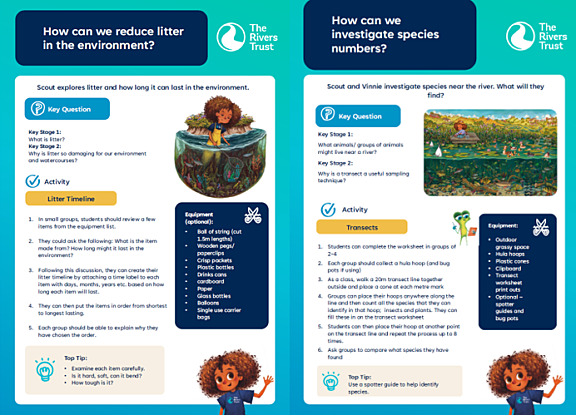
Recording species: This activity card demonstrates the ways in which we can investigate and record species numbers, and why counting creatures in this way is important. Learn about transects, plots and quadrats. Download here.
Explore the litter timeline: This activity card delves into how litter often ends up in our watercourses, and the long-lasting damage it causes. Download here.
Make art from plastic waste: Explore how we can recycle and reuse plastic to reduce waste, as well as the negative effects of plastics ending up in rivers. Download here.
This activity card explores what microplastics are and how they affect rivers and the environment. Download here.
Join The Rivers Trust's virtual ambassador, Scout, for a riverside adventure into citizen science. Use the Big River Watch app to survey your river, recording plants and animals. Download here.
River Lesson Plans & Materials
Designed by teachers, with schools, community groups and activity clubs in mind, these KS2 lesson materials (Powerpoint) and lesson plans (PDF) with written notes to support teaching are free and available for you to use in the classroom.
This lesson gives an introduction to what a river is, and what rivers are like, using the five senses. It helps with understanding a river's basic features, and offers an opportunity for students to create their own river representation.
This lesson investigates a river's journey from source to sea. Look at what the river may pass on its journey, including both human and physical features. Explore local rivers and their characteristics with creative opportunities to represent the river journey using art, modelling or practical activities.
This lesson is an exploration of how rivers connect to the water cycle, and invites students to create their own water cycle model.
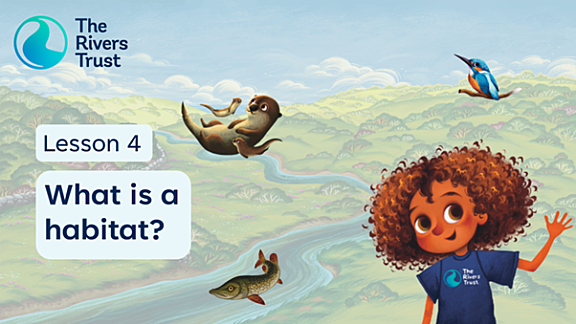
Take a look at the features of habitats, and river habitats. This lesson looks at what animals need to survive and explores the difference between good and bad habitat features.
This lesson looks at the different groups of animals and the plants that live in and around a river habitat. It explores their common features and adaptations for life in a river habitat.
Case studies
From the migratory patterns of trout and eels to mitigating flood risk by creating a rain garden, our local Trusts carry out all sorts of different schools and education projects every year.
Bristol Avon Rivers Trust: Eel in the Classroom

Eel in the Classroom teaches pupils about the iconic life journey of the European eel. Each glass had a tank of elvers to look after for a term, before releasing them back into the river to head to a safe spawning ground.
Schools Engagement with SuDS
Without a doubt, climate change is making our weather increasingly volatile and causing a domino effect of environmental problems. As towns and cities grow and more land is covered in concrete and tarmac, more and more pressure is put on our water system. Water runs off from these surfaces where, in the past, it would have been absorbed by soil and filtered as part of the natural water cycle. One way to try and improve this situation is by using Sustainable Urban Drainage Systems, otherwise known as SUDS. South East Rivers Trust have been teaching school students all about this through their “SUDS in the classroom” project. Watch this video to hear from Charlene Duncan, SERT’s Education and Community Outreach Officer, on the initiative.