Interreg NWE Wetlanders
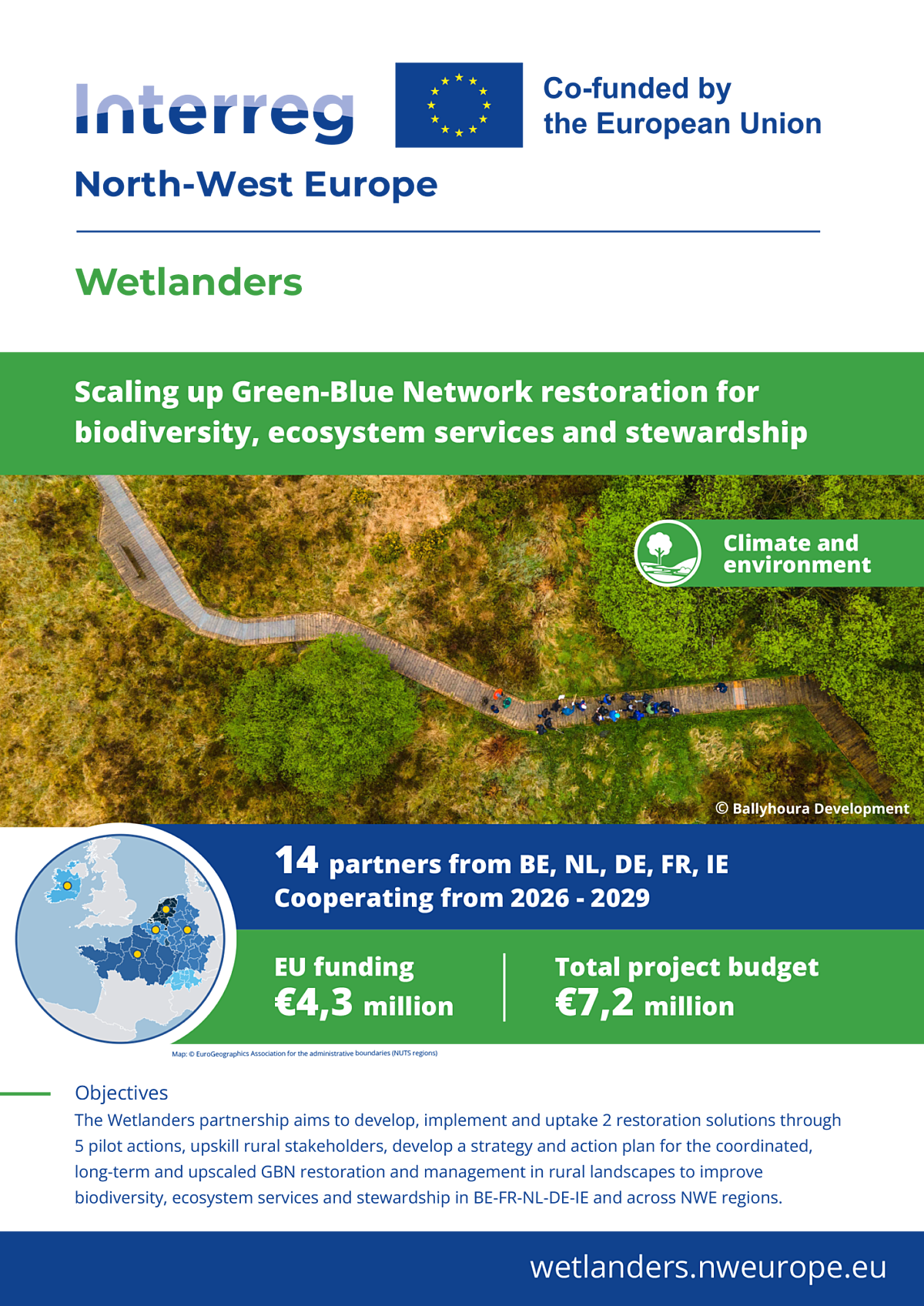
Wetlanders, a project co-funded by the Interreg North-West Europe programme, brings together 14 organisations from 5 countries to reverse the trend of wetland loss across North-West Europe, through shared tools, hands-on restoration and the local partnerships needed to support long‑term stewardship.
Across North‑West Europe, green‑blue networks (GBNs) are disappearing at an alarming pace. Some regions have already lost more than 90% of their wetlands, while others are facing extensive peatland degradation. These are the ecosystems that filter water, store carbon and sustain biodiversity, yet they are shrinking faster than we currently can protect them.
Wetlanders, a project co-funded by the Interreg North-West Europe programme, brings together 14 organisations from 5 countries to reverse this trend, through shared tools, hands-on restoration and the local partnerships needed to support long‑term stewardship.
Working together to restore Europe’s GBNs
Wetlands face many challenges, such as fragmented ownership, inconsistent governance and shrinking funding. These issues span borders and require solutions that do the same. That’s why Wetlanders connects partners from Belgium, France, the Netherlands, Germany and Ireland, creating a platform for shared expertise on an entirely new scale. Led by the Belgian NGO Natuurpunt, the consortium combines the strengths of research institutes, public authorities, and land managers.
Testing on the ground and developing the GBN tool
To turn theory into practice, we are implementing 5 pilot actions across diverse landscapes in four countries ranging from lowland river valleys and peatlands to sinkhole lakes and headwater springs. Here, we tackle both abiotic challenges, such as restoring natural water flows, and biotic threats, such as the removal of invasive species and unnatural plantations. The successful restoration methods and solutions tested at these sites will be compiled into the GBN tool. This publicly available digital platform will ensure that the solutions we develop can be easily accessed and replicated by other regions.
Strengthening skills, stewardship and collaboration
The people closest to these landscapes, such as farmers, land managers, local authorities and community groups, are also the ones best placed to protect them. Wetlanders works directly with these groups, building the knowledge and skills needed for ongoing guardianship. A joint strategy and action plan across all five countries ensures that this collective effort achieves more than the sum of its parts.
A crucial part of this plan involves exploring innovative conservation finance models, such as public-private partnerships and ecosystem service credits, ensuring that GBN restoration remains financially viable long after the project ends.
Our why
When GBNs function well, their positive effects are felt far beyond the water's edge: cleaner rivers, more resilient communities and landscapes that can withstand both drought and flooding. Wetlanders demonstrates what successful restoration looks like and creates the conditions for it to happen again elsewhere.
“By connecting people, partners and landscapes, we’re here to restore what these ecosystems have lost.” - Katrien Wijns, project coordinator
Updates and results
We will share regular updates, insights, and results as the project progresses. You will also find key news and developments on the Wetlanders Interreg NWE website.
Our role as a Wetlanders project partner
The Rivers Trust (TRT) primary role in Wetlanders is overcoming societal obstacles through raising awareness, building support, and increasing technical and managerial capacity. In doing so, we aim to upscale community-driven nature restoration.
Training: TRT will guide the development of training sessions to equip stakeholders with the technical and managerial skills needed to implement and sustain Green and Blue Network (GBN) restoration. TRT will exchange inter-regional best practices and strengthen cooperation with other Wetlanders partners. TRT will also work closely with the Irish pilot site partner, Ballyhoura Development, to tailor the training sessions to an Irish context while also contributing to broader North-West Europe (NWE) learning objectives.
Local awareness and stakeholder engagement: TRT will help to develop and implement communication strategies at the pilot site level. In Ireland, we will collaborate with Ballyhoura Development, as they are the project partner coordinating the Griston Bog pilot site. TRT will help in producing promotional materials, supporting community workshops, and sharing success stories from past restoration efforts. This involvement ensures that technical training is complemented by strong community engagement to ensure long-term project success.
In summary, TRT’s contributions will bridge the gap between scientific knowledge and community-driven action. By leading training development, supporting local engagement, and fostering international collaboration, TRT enhances the project’s ability to deliver sustainable, replicable restoration solutions.
Project funding
EU funding: 4,3 million
Total project budget: 7,2 million
Project duration
Cooperating from 1 January 2026 - 30 June 2029
Partner information
The Wetlanders partnership brings together 14 organisations from Belgium, the Netherlands, Germany, France and Ireland, combining expertise from research institutes, NGOs, public authorities and land managers across the NWE region.