[The Source Code] A new guide for designing a wetland
Wetlands offer myriad ecological benefits — from wildlife habitat and drought resilience, to the capture of nutrient pollution. The Wetland Mitigation – Detailed Design Guide, shares design principles that ensure wetlands are effective, sustainable, and capable of delivering nutrient reductions.
Part of [The Source Code] series: regular tech and data insights from The Rivers Trust’s Heather Bell, celebrating the digital tools and teams powering environmental change. Sign up to our newsletter to get every piece delivered to your inbox.
23/10/25
Nutrient pollution from agricultural runoff, sewage, and industrial waste can cause eutrophication to occur in freshwater habitats. A familiar term to many, thanks to GCSE Science classes, eutrophication is a common phenomenon during which waterbodies become excessively enriched with nutrients such as nitrogen and phosphate, which allow plants to grow rapidly and algae to bloom.
This process chokes streams, rivers and lakes, and the effects can also reach into the marine environment. Water becomes oxygen-depleted (H2Oh dear). The signs can be visible – mats of green and smelly algae, and dead zones, which can harm aquatic wildlife and lead to fish kills.
Wetlands are nature’s filters, removing pollutants through physical, chemical and biological processes. By doing so, they offer us a solution to some levels of nutrient pollution. And that’s not all. Wetlands are foundational to water security as they modulate the flow and storage of water during periods of flood and drought - a key component of Earth’s watery ecological network. Despite their importance, and the benefits they provide, many of these critical habitats have been lost around the globe in recent decades.
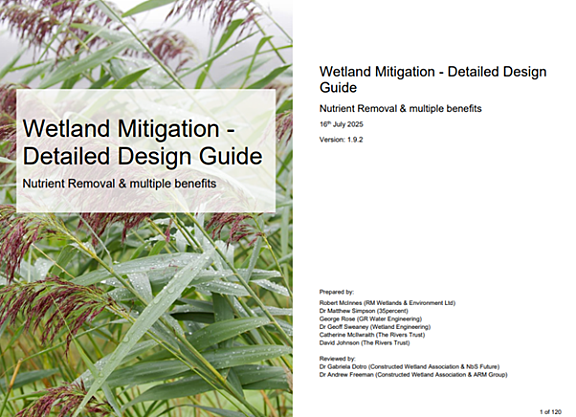
The Rivers Trust has developed a free, open access design guide for constructed wetlands. Harnessing the power of wetlands through the principles in the design guide, nutrients can be predictably removed from freshwater, reducing issues downstream.
The guide advises on constructing, commissioning and maintaining wetlands, with calculations for how much nitrogen and phosphate will be reliably removed. We’ve also built a data explorer with a map of information including soils, topography, geology and land use, to allow users to build a picture of how feasible a wetland may be in reducing nutrient pollution.
📖 Click to read or download the guide
🖱️ Click to explore the other resources and information available in our Constructed Wetlands Hub