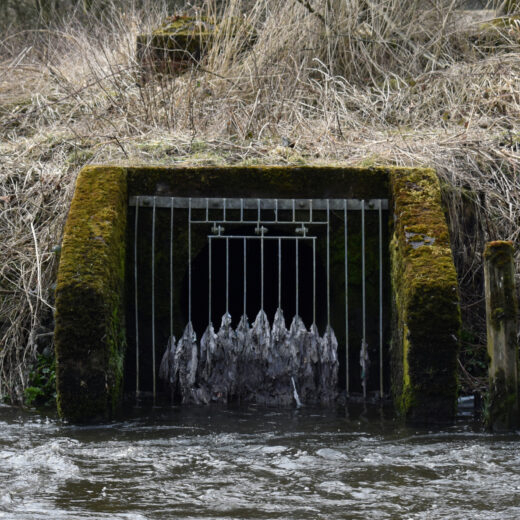
The issue – why is it relevant to the work of The Rivers Trust.
According to official data, accessible via The Rivers Trust’s Sewage Map, water companies in England discharged raw sewage into waterways via Combined Sewer Overflows (CSOs) for an all-time high of over 3.6 million hours in 2024. Despite the significant increase in attention paid to this issue in recent years, and the uptick in regulatory activity, the sector clearly has a long way to go to fix this unacceptable pollution of our water environment.
Combining raw, untreated sewage with rainfall runoff from buildings, pavements, and roads, CSO discharges can contain a wide range of pollutants, such as faecal pathogens (including bacteria resistant to antibiotics), industrial chemicals, personal care products, pharmaceuticals, microplastics, heavy metals, oils and solids such as wet wipes. When released into our rivers, this cocktail of contaminants can have seriously negative impacts, including:
- Serious risk to public health, through people coming into contact with contaminated water when using our waterways for swimming, kayaking, fishing, etc.
- A huge range of chronic and acute effects on aquatic wildlife and plantlife; pollutants can cause death, physical injury, adversely affect natural behaviours such as reproduction, and damage critical habitats.
- Contamination of shellfisheries in estuarine waters, which impacts businesses.
CSOs have widespread and chronic impacts on our waterways. As set out in the State of Our Rivers Report 2024, 11% of river stretches in England fail to achieve a good overall bill of health as a result of these kinds of untreated sewage discharges. Without concerted action, the frequency of CSO discharges will only increase, as climate change increases the frequency and intensity of rainfall events and population growth adds further pressure on the existing sewage system.
It is essential that The Rivers Trust continues to press for action on this systemic issue that causes serious damage to our rivers, the wildlife they support, and local communities.
What are the contentious aspects?
CSOs are a necessary ‘safety valve’ in the sewer system, designed to prevent sewage backing up and discharging via toilets and sinks into people’s homes during periods of extreme rainfall. However, it has become clear that this ‘safety valve’ has been abused by the water sector, as a result of failures to increase capacity in the system. In recent years, the evidence has mounted, for example through the Environmental Audit Committee’s inquiry, that shows CSOs are being used routinely by water companies, even when there is no rainfall and not only during ‘extreme rainfall events’, which is when they are legally allowed to be used.
As more of the CSO network has been monitored and better data has become available, it has become clear that the frequency of CSO usage is unacceptable and is the result of a widespread failure of governance, regulation and underinvestment in key assets. The regulators Ofwat and the Environment Agency have since launched investigations into all 11 water companies in England and Wales and have so far confirmed enforcement packages against 7 due to failures to properly maintain their wastewater systems and overuse of CSOs. At the same time, the Office for Environmental Protection has found that Defra, the Environment Agency and Ofwat have themselves breached environmental law regarding CSOs. These activities clearly show that the regulatory regime around CSOs has not been performing as required.
A key contention now is about how to fix this chronic problem. In recent years we have seen a lot of new legislation and regulatory changes that aim to get a grip on the issue, for example:
- The Environment Act 2021 created new requirements to reduce CSO discharges and the harm they cause;
- The Water (Special Measures) Act 2025 created new powers for regulators to hold companies to account and more strictly control executive bonuses;
- The Environment Agency set stricter regulatory guidance and permit thresholds around CSOs, and has significantly expanded its water enforcement workforce.
Many of these changes are in their early days, however, with overall performance on CSO discharges not improving, it is clear that we must keep the pressure on. The government’s response to the Independent Water Commission offers us a crucial opportunity to drive reform of the whole water system, including on sewage pollution.
What is our position?
The Rivers Trust has consistently called for more effective regulation of water companies, to ensure that CSOs are used legally and within their permit conditions. Over many years, we have engaged with fellow environmental and community groups, parliamentarians, government departments, regulators and the water companies themselves, to push hard for stronger accountability, consistent enforcement of the law, and adequate funding and direction for regulators to do their job properly. We have also made clear that water company fines for pollution incidents should be ringfenced for environmental improvements, rather than being lost to wider government coffers.
A key focus of our work has been demanding greater transparency from water companies and the regulators. We are clear that transparency and ensuring data is openly accessible is critical, as it empowers us all, public, campaigners, parliamentarians, etc., to understand the issues and hold the sector to account. Our Sewage Map, first launched in 2019, was one of the earliest platforms to make sewage discharge data accessible to the public, since then it has played a key role in pushing this issue firmly up the political agenda. The Rivers Trust has played an instrumental role in getting a requirement for near-real time reporting into the Environment Act 2021 and successfully campaigned for all water companies to publish this data on one, easy-to-use platform. Now, with close to 100% monitoring coverage across CSOs, we are all able to see for ourselves how the sector is performing in this area and have better tools to hold them, and the regulators, to account.
Recently, the launch of the Independent Water Commission presented a significant opportunity to reset the sector and transform the health of our waterways. In our response, The Rivers Trust set out the need for a clearer and more effective legislative and regulatory framework, and for greater focus on maintenance and resilience. We made absolutely clear that transformative change is necessary to ensure that public health and the environment are prioritised over profits. The Rivers Trust is continuing to press the government to act more urgently and with more ambition as it rolls out reforms.
Alongside this necessary pressure on water companies, The Rivers Trust also stresses the need to tackle the upstream pressures on our sewage system, as CSO discharges can be a symptom of wider land use, e.g., development and building design. We need to “sponge-ify” our developments, through greater use of sustainable drainage systems, so that rainwater can soak into the ground instead of adding unnecessary extra pressure on our sewage system. Planning policy needs to be strengthened in this area.
What are we doing about this issue?
The Rivers Trust has been active for many years on the issue of sewage pollution and the overuse of CSOs. For the last 6 years we have published our Sewage Map , which has helped to bring data, evidence and transparency to the fore in public discussions about sewage pollution, and we will continue to do so.
We continue to look for new ways to improve monitoring and make it as accessible and collaborative as possible. Our biannual Big River Watch campaign gets people out to their rivers and using a simple survey to notice and record sewage pollution; individual surveys add up into a national dataset that helps paint a picture of the health of our rivers. The Rivers Trust also co-leads the Catchment Systems Thinking Cooperative project (CaSTCo), which aims to develop a comprehensive, collaborative monitoring framework, including citizen science and various other forms of data, to inform official decision-making.
For many years now, The Rivers Trust has played an active role in bringing the issue of CSO misuse to light and pressing for more ambition from leaders to tackle the issue:
- In 2020, as members of the #EndSewagePollution Coalition led by SAS, we called for legislative action on sewage pollution and more transparency CSO discharges.
- During the passage of the landmark Environment Act 2021, The Rivers Trust worked closely with MPs and Peers to strengthen requirements on water companies. Ultimately, the Act created critical duties to reduce CSO discharges and harm caused by them, and report publicly on CSO discharges.
- The Rivers Trust participated in Defra’s Taskforce on CSOs and continued to push for more ambition and urgency on tackling the issue; we maintained our critical voice throughout our engagement with the Taskforce.
- The Rivers Trust joined forces with other environmental and campaign groups to urge water companies to publish real-time sewage discharge data in an open and accessible way. This led to the launch of the National Storm Overflows Hub and allows us to publish live data on our Sewage Map.
- The Rivers Trust movement joined forces to demand that water company fines for environmental harms should be ringfenced and spent on restoring that same environment, rather than being lost to general government coffers.
- Through joint work with the Blueprint for Water coalition, we have pushed for stronger water company business plans and more effective regulatory rules and processes.
- Our response to the Independent Water Commission secured sign-on from members of the Rivers Trust movement and made a clear case for holistic improvement of the water environment, including the need for a stronger regulatory framework, more joined-up planning and delivery, and more nature-based approaches.