
Sewage Discharges: England and Wales’ 2025 Annual Summary Data released
Even in a significantly dry year, water companies still discharged untreated sewage into rivers, lakes and seas almost 400,000 times in 2025, for over two and a half million hours — spelling continued disaster for our waterways.
26/03/26
News
Last year, sewage was discharged into England and Wales’ waterways for over two and a half million hours - 2,651,296 to be precise. Discharges occurred a total of 386,466 times. Today, data from water companies in England and Wales was released, containing information about raw sewage discharges into English and Welsh rivers during 2025. One thing is clear: it’s been another terrible year for sewage in our rivers.
According to today's data:
- Raw sewage was discharged into England’s rivers for over 1.8 million hours (1,873,751), a total of 291,492 times in 2025. This is a 35% decrease in total hours, and 48% decrease in total number of discharges.
- Raw sewage was discharged into Wales rivers for 777,545 hours, a total of 94,974 times in 2025. This is a 17% decrease in total hours, and 16% decrease in total number of discharges.
To see the breakdown by water company, scroll to the bottom of this page.
Raw sewage is a key polluter of rivers, contributing to many stretches failing their health assessments. It contains excrement, sanitary products and pharmaceuticals, and is mixed with rainwater (which can contain its own cocktail of toxic chemicals) before being released into rivers through Combined Sewer Overflows (CSOs) instead of reaching a sewage treatment plant.
Is the situation getting better or worse?
In total, this is less than the number of hours reported in 2024. But, that’s far from the whole picture.
2025 was a significantly drier year - especially in the North, Midlands and the East. In fact, every region in Scotland, Wales and England was drier in 2025 than the previous 12 months. Several regions, including Yorkshire, North West England, Midlands, and parts of Sussex, were declared in a state of drought during the summer months, and water levels in many rivers were very low. Raw sewage is only supposed to be released into rivers during heavy rains, so we’d expect fewer discharges to have occurred. ‘Dry spilling’ is an illegal practice.
The low flows make the impact of sewage on rivers even worse. With less water in the river to dilute any sewage that entered, these already-stressed ecosystems and aquatic life are exposed to even higher pollution concentrations. At the same time, more people will be taking to rivers and seas to cool down on hot days, putting public health directly at risk.
““We expected to see a lower number of sewage discharges in 2025 as it was such a dry year, but this should not be mistaken for progress. Nearly 300,000 is still far too many and many of these are likely to be illegal. There is a lot of public money now being spent on water infrastructure after decades of underinvestment and regulatory failure. We need to know this is being spent in the right ways to put an end to pollution and protect both people and nature.””

Michelle Walker
Technical Director, The Rivers Trust
2025 was the first year with live data
Water companies in England and Wales have to share real-time CSO alerts for sewage dumps starting and ending – something that The Rivers Trust has campaigned hard for over the past decade. While the live Welsh data sources aren’t yet available to us, we integrated the live data for England and Scotland into our Sewage Map – adding a new ‘real-time alerts’ tab.
Live alerts are important for helping communities understand potential risks and pollution in real-time, as well as helping identify key polluters, misconnected systems and dry spills (something the annual data doesn’t show).
But the live data is really, really poor quality
Our experts have spotted differences between the live data and the annual summaries reported by water companies. We receive event duration data – the time a CSO begins to discharge, and the time that it stops. There’s no way to tell the volume of water or sewage being released during those points. On some occasions the monitors, which are located at each CSO, get triggered incorrectly – for example if wildlife or weather triggers the sensor – but because the live alert is sent in real-time, it’s not manually verified. It’s also inconsistent – sometimes we receive a stop signal without a previous start signal, or a stop signal never comes.
If you add up all of the year’s live discharge event alerts, and count the time these signals indicate discharging has taken place for, the totals are very different from the annual summary data reported by water companies today. Our technical experts have identified stop and start times that have been edited, and some entire discharge events removed – all without explanation. To restore rivers and fix the system, it is essential that water companies are transparent about why the data is edited, so that we can have confidence in the information we’re being presented with.
What do you know about treated sewage?
Did you know, it’s not just raw sewage that’s a problem for our rivers? In fact, treated sewage also poses a huge threat – in some cases, causing even more damage. That’s not to diminish the problems caused by raw sewage, but to emphasize how dangerous even what comes out the other end of treatment plants can be. Treated sewage can still contain myriad chemicals, pharmaceuticals and dangerous bacteria such as E.coli, and the nature of treated sewage is that it can be almost continuously discharged, presenting a chronic problem for rivers and wildlife.
Hear more from the experts
To learn more about sewage treatment, listen to our Rambling About Rivers podcast episode about sewage pollution in rivers, which includes an interview with The Rivers Trust’s Simon Browning. Listen on Spotify or Apple Podcasts.
Breakdown by Water Company:
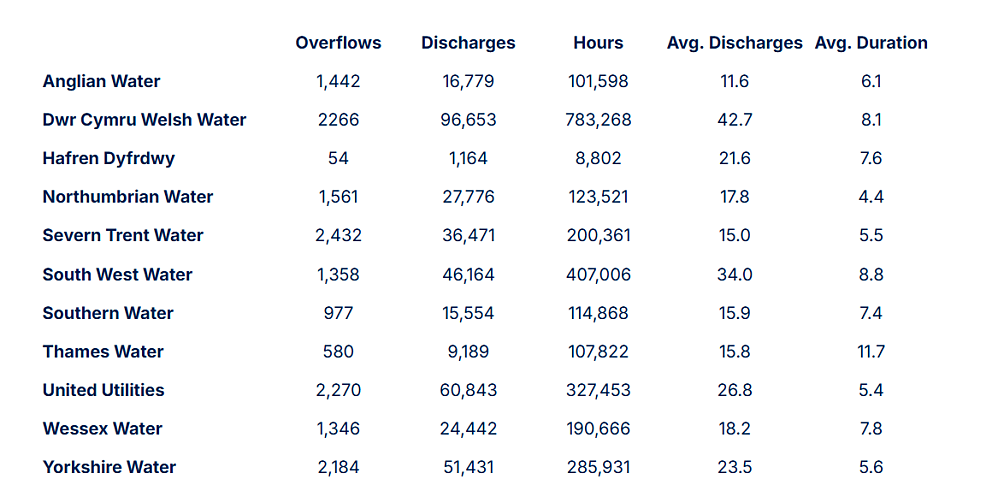
Our experts are cleaning up this data and will add it to the Sewage Map Annual Summaries tab in the coming days.
What can you do?
For more information and regular opportunities to get involved, sign up for our newsletter. To support our vital work fighting for healthy rivers, donate to The Rivers Trust.